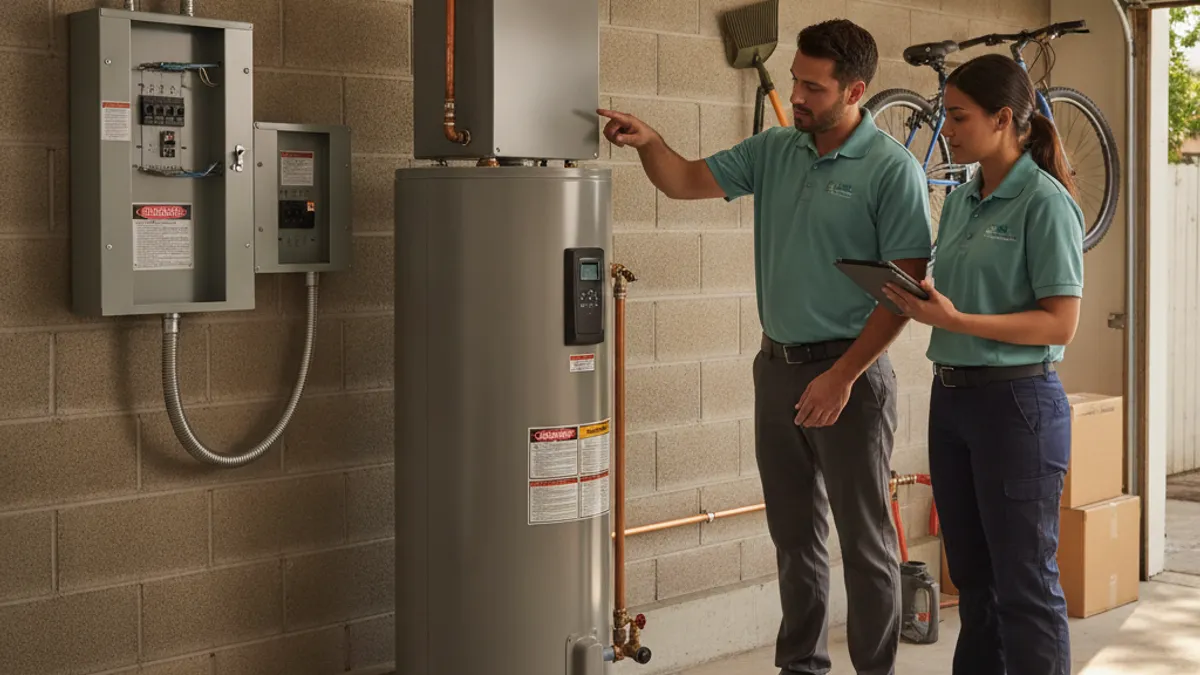
A different machine than the tankless gas unit you’ve been comparing
If you searched for tankless water heater pricing and landed here, pause. A heat pump water heater is not a tankless unit and it doesn’t run on gas. It’s a tank-style water heater with a small heat pump on top that pulls warmth out of the surrounding air and moves it into the water, similar in idea to how a space-conditioning heat pump moves warmth in and out of the house.
Heat Pro SD matches licensed HVAC heat-pump work only. We do not match water-heater electrical or plumbing work, and we do not install water heaters. A heat pump water heater typically needs the trades licensed for plumbing and for the electrical circuit, plus whatever the building department requires for the address.
How it actually heats water
A standard electric resistance water heater turns electricity directly into heat. A heat pump water heater uses a compressor and refrigerant loop to extract heat from the air in the room and concentrate that heat into the tank. Because it is moving heat rather than generating it, the manufacturer literature for a given model will state how that unit uses electricity compared with a resistance tank. Ask for that model’s published ratings. This page does not publish a UEF band or a “times less electricity” figure.
The tradeoff is placement. These units pull heat out of the air around them, which cools and dehumidifies that space.
Garage versus closet: the placement questions to keep
Ask the plumber or the manufacturer instructions, not a countywide rule:
- Is the proposed room a garage, a utility room, or an interior closet?
- Does the manufacturer require a minimum room volume, or ducting to another space, for this exact model?
- Where will condensate drain, and is there already a drain path?
- How close are bedrooms, and what does the manufacturer say about sound during a heating cycle?
- If the unit is going in a small closet, does the design include intake and exhaust ducting so the room is not starved of air?
A garage with decent airflow is often the placement manufacturers discuss. A small, poorly ventilated interior closet is the placement that most often needs extra ducting or a different product. Keep those as questions. Do not treat a cubic-foot number on this page as the spec.
What drives cost, without a local price table
Heat Pro SD does not publish an installed price for heat pump water heaters. Compare itemized quotes from the appropriately licensed trades. Line items that often change the number include:
- Electrical work. Many units need a dedicated circuit. An electrician has to say whether the panel can accept it. Older homes in neighborhoods like City Heights and Normal Heights sometimes need panel work first. That is an electrical conclusion, not an HVAC matching scope.
- Condensate drainage. These units produce condensate. If the garage doesn’t already have a floor drain or a nearby drain line, running one is plumbing work.
- Ducting the intake and exhaust. Smaller attached garages, including some older Point Loma or North Park houses, sometimes need the unit ducted so it doesn’t starve the space of air. Ask the installer to show the manufacturer’s ducting option for that model.
- Removing or capping a gas line. If you’re switching away from a gas water heater, capping the old gas line is plumbing work.
Get those as written lines. Do not use a round installed band from an article as your budget.
Where incentives fit in
Do not build incentive dollars into your budget until the installer confirms current status in writing.
TECH Clean California publishes single-family incentive status at techcleanca.com/incentives/single-family-incentives. As of November 14, 2025, that page reported TECH single-family heat pump water heater and heat pump HVAC incentives as nearly reserved statewide. As of January 7, 2026, HEEHRA single-family rebates for Southern California were reported fully reserved. As of February 24, 2026, HEEHRA single-family rebates were reported fully reserved statewide. Those dated lines do not mean a rebate applies to your water heater.
Federal credits are administered by the IRS. Confirm current law with a tax advisor. SDG&E program status was not verified for this page.
Hard water and maintenance in San Diego
San Diego’s water supply runs hard. Mineral buildup inside any tank-style water heater, heat pump or otherwise, is a real maintenance topic here. Ask the manufacturer how often to flush the tank and check the anode rod for that model. Skipping that maintenance is a common reason a unit underperforms years later. A whole-house softener is a separate plumbing decision. It is not required by this page, and it is not an HVAC matching service.
Does it make sense for your house
A heat pump water heater can be a strong fit if you already have space for the tank and airflow, if you are planning to leave gas water heating, and if the electrician confirms the circuit. It’s a weaker fit when the only location is a cramped interior closet and the manufacturer requires more air than that closet can provide, or if the panel cannot support the circuit without work you are not ready to fund.
Running-cost comparisons belong on the quotes and your actual utility rates, not on an unsourced payback period.
How long does a heat pump water heater last?
Ask for the warranty documents on the tank and on the heat pump component. This page does not publish a year range. Real-world life depends on water quality, flushing, and the anode rod, which the plumber or manufacturer should explain for that unit.
Is a heat pump water heater loud?
It has a small fan and compressor during heating cycles, so it is not silent the way a resistance tank can be. Ask for the manufacturer’s sound data and place the unit where that sound is acceptable. A garage away from bedrooms is the usual question. It is not a loudness ranking against a central AC.
Does a heat pump water heater work in a cold garage?
Performance depends on the air temperature the unit can extract heat from. San Diego garages are milder than a freezing climate, but the installer still has to follow the model’s operating range. Ask for that published range.
If you need a licensed HVAC contractor for a space-conditioning heat pump, see heat pump replacement services or call (858) 400-4374. Heat Pro SD matches San Diego County homeowners with licensed independent HVAC pros for heat-pump HVAC work. We perform no physical work, and we do not match water-heater plumbing or electrical jobs. The number routes to voicemail with a recording-consent notice.