When a heat pump in San Diego starts blowing weaker air, the coil is often dirty, not dead. A heat pump cleaning service is the paid visit where a licensed independent HVAC contractor opens the cabinet, washes the parts a hose cannot reach, and tells you if dirt is the whole problem. Heat Pro SD does not clean equipment. We match homeowners with those licensed local pros.
What a professional heat pump cleaning visit usually includes
A professional heat pump cleaning visit is not a filter swap and it is not a five-minute rinse. The licensed contractor who shows up is there to get dirt off the heat-exchange surfaces and out of the water path.
On the indoor side, that usually means opening the air handler or the mini-split cabinet. The pro lifts panels, reaches the indoor coil, and cleans the blower wheel that actually moves air. Dust packed on that wheel cuts airflow even when the filter looks fine. The pan under the coil gets cleared, and the condensate line gets flushed so water can leave the house instead of sitting and smelling musty.
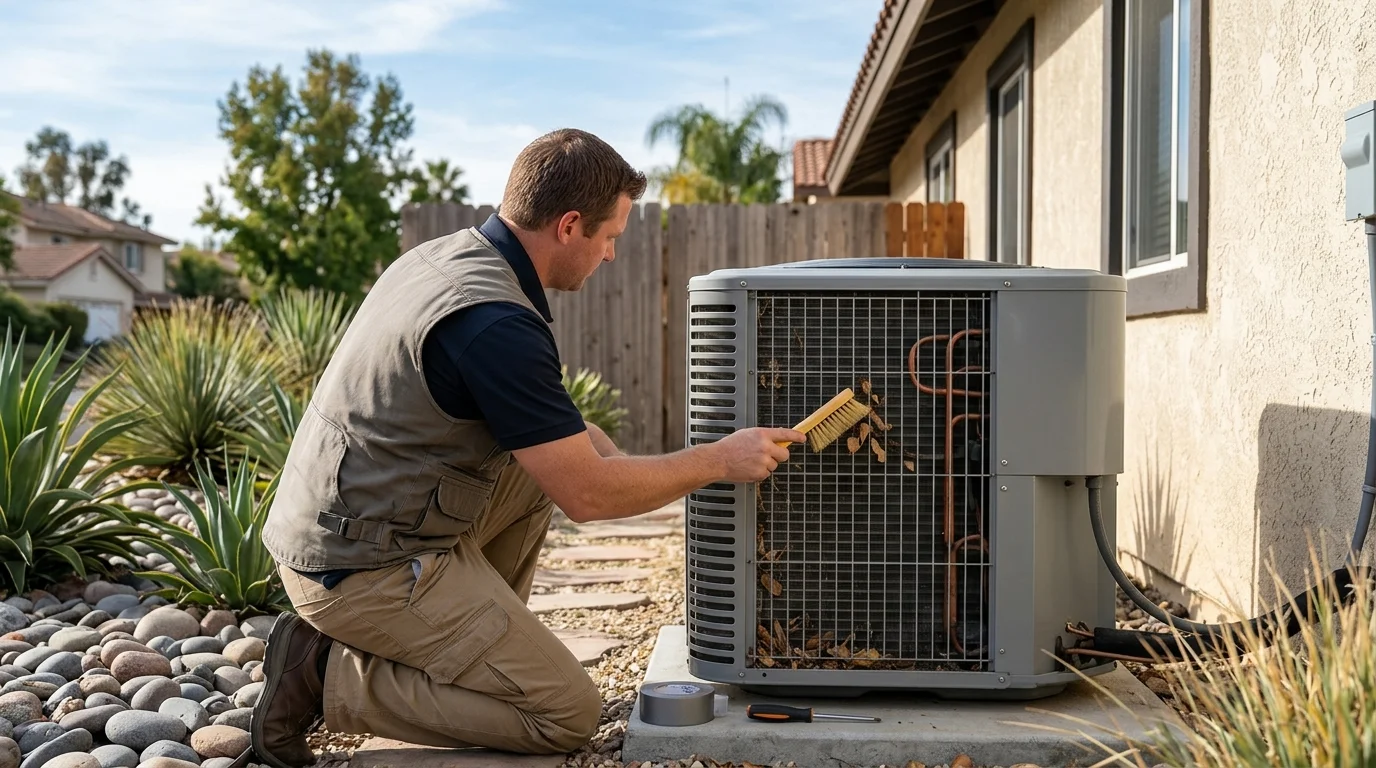
On the outdoor side, the job is the condenser coil and the area around the fan. Leaves, seed fluff, and dried mud pack between the fins. A careful wash, following the manufacturer’s method for that model, is the point. The pro should also look at the fins for bending and at the cabinet for rust, especially on the coast.
Filters still matter, and they are a separate decision. Some you wash. Some you replace. That choice lives on our heat pump filter cleaning or replacement guide. A cleaning service may handle the filter while the cabinet is open. It should not be the only line on the ticket.
A maintenance tune-up can include this cleaning and then go further: a look at how the system is running, electrical connections, and notes on parts that are wearing. If all you asked for is heat pump coil cleaning in San Diego, get that scope in writing so you know what was skipped.
When the dirt is inside the cabinet, a licensed HVAC contractor is the person to do the work. Live equipment, hidden coils, and drain lines inside a wall cassette are not a Saturday chore. When the job is a dirty filter or a light outdoor rinse the manufacturer allows, you can often handle that part yourself.
How this differs from rinsing the outdoor unit yourself
You can keep an outdoor unit clearer between pro visits. Our guide to cleaning a heat pump outdoor unit covers that homeowner work: power off, debris pulled by hand, a gentle rinse if the maker allows it. That page is the DIY sibling. This one is the paid service.
A garden hose does not reach the indoor coil. It does not lift a mini-split blower. It does not flush a drain that exits through a wall. It also does not tell you whether flattened fins, a bent fan, or a rusted base pan is already limiting the machine.
Pressure is the usual DIY failure. A high-pressure spray can fold aluminum fins shut, and a closed fin is worse than a dusty one. Manufacturer instructions set the method for that model. If the booklet says do not spray from the outside in, follow that. If it says stay off the electrical compartment, stay off it.
Professional heat pump cleaning is the visit that opens what you cannot see. The pro decides whether the outdoor coil needs more than a rinse, whether the indoor coil is matted, and whether the blower needs to come out. You should still do the simple outdoor care. You should not treat that care as the same job.
If a company only quotes “rinse the condenser” and never mentions the indoor coil or the drain, you are not buying a full cleaning service. You are buying a hose with a labor line.
How ducted systems and mini splits are cleaned differently
Ducted heat pumps and mini splits collect dirt in different places, so the cleaning is not interchangeable.
A ducted system in a Mira Mesa garage, a Chula Vista attic, or a Rancho Peñasquitos closet hides the indoor coil in the air handler. The pro works in a tight cabinet. The blower, the evaporator coil, and the drain are in that box. Supply ducts can dump dust onto the coil for years, especially if returns are leaky or filters are the wrong size. Cleaning the outdoor unit alone leaves that indoor mess in place.
A mini split puts the indoor coil behind a wall cassette, a ceiling cassette, or a slim floor unit. Each head is its own cleaning job. The front panel comes off. The filter screens come out. The coil and the blower wheel inside that head are what actually need washing. A three-zone house in North Park or an ADU in Golden Hill is three indoor cleanings plus one outdoor unit, not one quick stop.
Drainage is the other split. Mini splits in coastal humidity send a lot of water through a small line. A clog shows up as a drip from the head, a musty smell, or a shut-down on a float switch. Ducted air handlers use a pan and a line too, but the leak often shows in a closet, a garage ceiling, or an attic. The proposal should say which drains get flushed.
Multi-zone systems need an honest head count. Cleaning the outdoor unit and one bedroom head does not clean the living-room cassette. Ask the pro to list every indoor unit on the ticket. If one head is in a garage workshop and another is over a kitchen, they will not be equally dirty, and they should not be billed as a mystery bundle.
Why coastal salt and inland dust change the job
San Diego County is not one climate for outdoor metal. A cleaning visit in Ocean Beach is not the same visit in El Cajon.
Along the coast, from Imperial Beach through Coronado, Pacific Beach, La Jolla, and Encinitas, salt rides the marine layer onto the outdoor coil. Fins crust. Cabinets rust at the base. Units tucked in side yards, under decks, or behind bougainvillea stay damp longer. Heat pump coil cleaning in those neighborhoods is often about salt film and corrosion, not just leaves. The pro should look at the metal, not only wash it.
Inland and in East County, the load is dust. El Cajon, Santee, Lakeside, Escondido, Ramona, and Alpine pull dry grit, pollen, and Santa Ana wind debris into the same fins. A condenser next to decomposed granite, a dirt yard, or an unpaved alley packs differently than a condensing unit twenty blocks from the water. Indoor filters in those houses load faster too, which puts more dust on the indoor coil.
South Bay sits in the overlap. Chula Vista and National City get salt on some days and freeway dust on most days. An outdoor unit along a busy corridor collects a gray cake that a light rinse will not move.
None of this sets a calendar by itself. Your owner’s manual sets service interval language, and the licensed pro who sees the fins should say whether this visit is a wash or a warning. A blog cannot invent a county-wide schedule. What it can say is this: coastal salt and inland dust change what “dirty” looks like, and a proposal that treats Encinitas like Alpine is guessing.
What a written cleaning proposal should list
Ask for the scope on paper before anyone opens a panel.
The proposal should name indoor work and outdoor work as separate lines. It should say which coils, which blower, and which drains. On a mini split, it should name each head. It should say whether panels come off or the visit is an exterior wipe. It should say whether filter service is included, and whether that filter is washed or replaced.
It should also say what is not included. Electrical testing, refrigerant checks, and a full running inspection are extra on many tickets. If you want those, say so, and put them on the page. A cleaning visit that finds a problem should not turn into an open-ended repair without a new written figure.
License belongs on the paper. Heat Pro SD matches you with licensed independent pros. Look the license up yourself on the CSLB license check before the visit. Do not take a door hanger as proof.
Some search results talk about a “$5,000 rule” for HVAC. That figure is not in the California contractor statutes we verified. The numbers that are in statute are different. Under Business and Professions Code section 7048, work is exempt from the contractor license only when the total is under $1,000, the work is casual and minor, and no building permit is required, with that $1,000 threshold effective January 1, 2026. Splitting a job to stay under the line does not count, and anyone who advertises as a contractor loses the exemption. If the visit becomes a home improvement contract, section 7159.5 caps the downpayment at $1,000 or 10 percent of the contract, whichever is less. Confirm the current text with the CSLB and the Legislature. Do not treat a viral “rule” as the law.
Heat Pro SD does not publish prices, discounts, or waivers for this work. There is no verified public rate in our claims file for a cleaning visit. The matched pro quotes your system after they see it. If a number is not on the written proposal, it is not the price.
When cleaning is not the whole repair
Dirt explains a lot of weak airflow. It does not explain everything.
If the outdoor coil ices in weather that should not ice, or the indoor coil is clean and the air is still warm, cleaning will not finish the job. Charge problems, a failing part, or a control issue sit in repair territory. Ice on the outdoor unit, a system that cools but will not heat, or a unit that short-cycles after a wash are flags to stop treating this as housekeeping.
Drains can be clean and the house can still smell musty if ducts are dirty or a pan overflowed for a season. Ducted systems with crushed or leaky returns will reload a freshly cleaned coil. In that case the next step is diagnosis, not another wash.
Electrical faults, a dead outdoor fan, or a compressor that will not start are not cleaning items. The honest pro says so on the first visit and writes a separate repair proposal. California makes unlicensed contracting a misdemeanor under Business and Professions Code section 7028, unless an exemption applies. For anything beyond a simple, no-permit, sub-$1,000 casual job, you want that license in force.
When cleaning does not restore temperature or airflow, ask for a heat pump inspection. That visit is for measuring and finding, not for another rinse. Keep the cleaning paperwork. It shows what was already opened, and it keeps the next conversation honest.
When to call us
Call when the indoor coil, blower, or drain is past a filter and a hose, or when a written cleaning proposal needs a licensed HVAC contractor attached to it. Heat Pro SD does not send a crew and does not wash equipment. Call us at (858) 400-4374 and we’ll connect you with a licensed local HVAC contractor.