The first cold snap in East County is when dual-fuel logic shows up on the bill. A coastal house in Encinitas may stay on the heat pump all night. A house in Alpine or Ramona may need the furnace before sunrise. Dual fuel heat pump thermostat settings pick which plant runs, and they belong on the proposal before anyone hangs a thermostat.
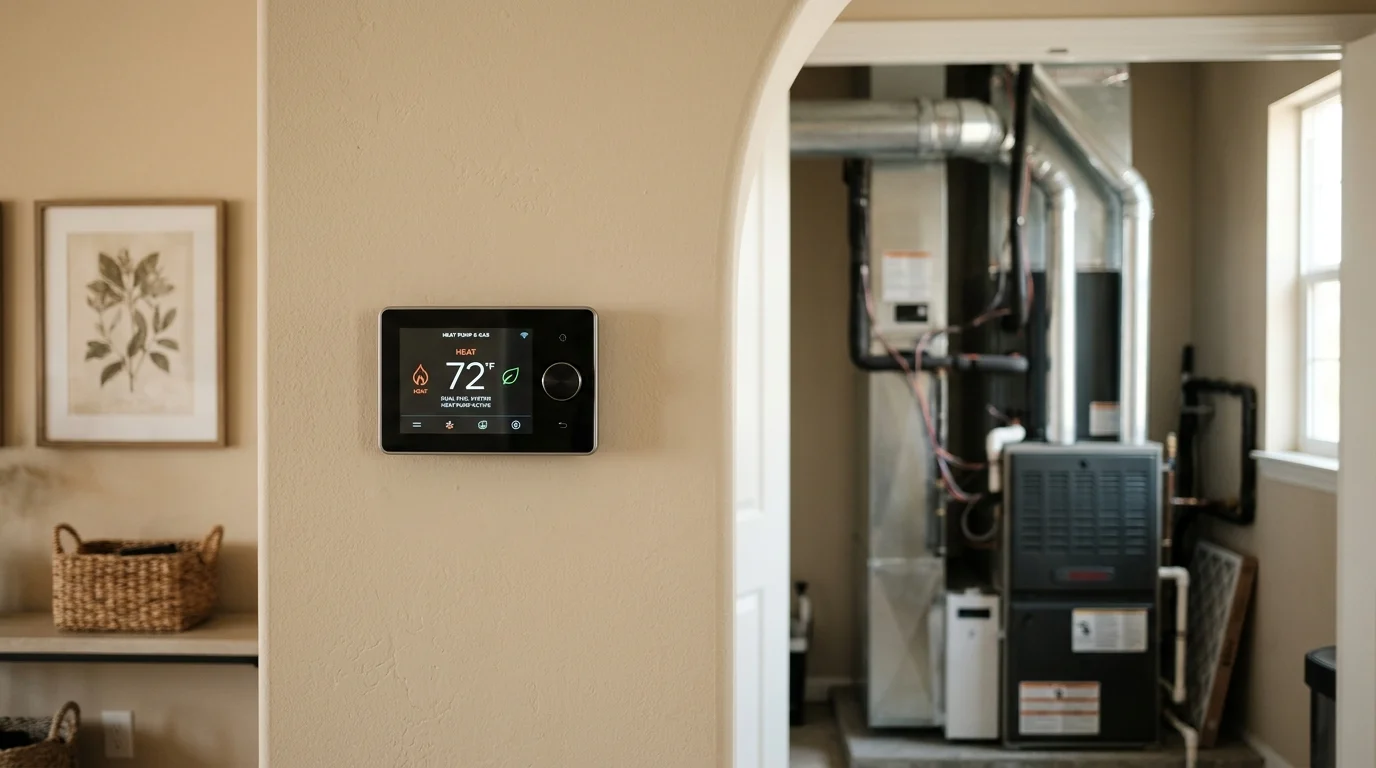
What the thermostat is controlling
On a hybrid dual-fuel system, the wall control runs two heaters and one cooling plant. The heat pump sits outside. In heating it moves warmth from outdoor air into the house through the indoor coil. In summer it runs in reverse and cools the house. The furnace sits indoors, usually under that same coil, and burns natural gas or propane when the control calls for it.
Those two heat sources share the blower and the ducts in a typical San Diego split layout. The thermostat has to choose a heating mode. It shouldn’t let the heat pump and the furnace heat at the same time. You pick an indoor setpoint. The control then decides whether the outdoor unit or the gas valve may answer.
Dual fuel heat pump thermostat settings live in the installer menu: system type, compressor stages, furnace stages, outdoor temperature source, and lockout or switchover values. A generic heat-pump-with-aux profile is the wrong shape. Electric strip heat and a gas furnace are different backups. If the matched contractor leaves the control in a strip-heat profile, the furnace can light while the outdoor unit is still in heat.
San Diego County hides this until the weather splits. Coastal North County nights often stay in a range the heat pump can handle. Inland valleys around Escondido, El Cajon, and Santee drop harder. East County and the backcountry see frost. South Bay flats stay milder, with colder pockets in canyons. There’s no single best indoor number. Ask to see dual fuel or hybrid on the thermostat and controls setup screen, in writing.
Why the two heat sources shouldn’t compete
A dual-fuel house is supposed to run one heating plant at a time. When both try to heat, you pay for two machines and the supply air can swing. On a common coil-on-furnace layout, the heat pump adds heat at the indoor coil while the furnace makes much hotter air below it. Dual-fuel sequences stop the heat pump, then let the furnace take the load. Heat pump furnace control settings exist to enforce that handoff.
A second cheap thermostat or a furnace-only switch doesn’t know what the heat pump is doing. That shows up as a furnace that lights on mild coastal nights. It also shows up as an outdoor unit that keeps running after the gas is already on.
The heat pump vs gas furnace choice is the equipment question. The control plan is the operating question. A Point Loma night and an Alpine frost morning are different loads in the same county, sometimes in the same week. Santa Ana winds and a marine layer can share a calendar week on opposite sides of the county. The control should follow that house, not a national default left in the menu.
Don’t force furnace heat from the app every time a floor feels cool. Tell the matched licensed contractor which rooms lag, and let that person change staging or airflow.
What can trigger a change between heating modes
A dual fuel heat pump switchover isn’t a random flip. The most common line is outdoor temperature against a lockout the installer sets. Below it, the furnace is allowed and the heat pump is held off. Above it, the heat pump is allowed and the furnace is held off. That number is a design choice for the house, the equipment, and current SDG&E gas and electric prices. It’s not a statewide rule. No universal outdoor switchover fits every San Diego County house.
A second line is indoor temperature falling behind the setpoint. Some controls then stage to the furnace instead of a second compressor stage. Ask whether slow recovery can call gas, or whether gas is reserved for outdoor lockout only.
A third line is setback recovery. Slam the setpoint up at dinner, and some controls grab the furnace to catch up on a mild La Mesa evening. Some internet guides mention a 20 degree rule for heat pumps. That isn’t a verified California code requirement. Don’t treat it as a switchover setting.
In summer the heat pump cools and the furnace stays off. Two thermostats usually means zoning or two systems, not dual-fuel switching. One control should own the pair. Ask which fuel the control picks if the outdoor sensor fails. A failed sensor in Ramona shouldn’t act like coastal air.
How outdoor sensors and equipment settings differ
Outdoor temperature is the input most dual-fuel logic leans on. A wired sensor at the house reads that lot. Mounting matters. A sensor in afternoon sun on a west stucco wall in El Cajon will read hotter than a shaded north wall. A sensor in the outdoor unit’s discharge air will read the machine.
Some thermostats pull weather from the internet. That can be fine on a mild coastal lot. It’s a poor stand-in for a canyon in Spring Valley or a ridge in the backcountry. Ask which location the control thinks you are in.
The heat pump may have its own outdoor thermistor for defrost and protection. That’s not always the lockout input. Heat pump furnace control settings on the wall control, the outdoor board, and the furnace have to agree.
Don’t copy wiring colors from a generic chart. Wiring is licensed contractor work. California treats unlicensed contracting as a misdemeanor under Business and Professions Code section 7028, unless an exemption applies. Confirm the contractor on the CSLB license lookup.
Some controls advertise a cheaper-fuel mode. That only works if the prices match what you pay SDG&E, including time-of-use periods. If that can’t be shown, stay on a temperature switchover the installer can explain. New equipment still has to clear a federal minimum efficiency rating. Confirm state program status with the California Energy Commission.
Questions to ask before changing a switchover setting
Leave the switchover alone until you can answer these with the matched contractor in the room.
Is this thermostat in dual-fuel mode, or heat pump with electric auxiliary? If the menu still says aux strips, stop. The gas furnace isn’t a strip kit.
Where does outdoor temperature come from on this lot? A Carlsbad courtyard and a Lakeside west wall aren’t the same reading. What dual fuel heat pump switchover value is in there now, and why for this house?
During morning recovery, is the furnace allowed to take over? If you wake up to gas on a mild Ocean Beach morning, recovery may be the real setting, not the lockout. Who holds the installer-menu lock after the job?
If a room is cold, is the next step airflow, sizing, or a control change? Changing lockouts won’t fix a duct that dumps heat into a Mission Hills crawlspace. Holding a steady, comfortable temperature is usually kinder to a heat pump than big setbacks.
If the handoff already feels wrong, that’s a visit for a licensed HVAC contractor, not a weekend in the installer menu. Heat Pro SD matches homeowners with licensed independent pros and doesn’t set the control itself.
What the installation proposal should document
The equipment list isn’t the control plan. Before you sign, the proposal should write down how the pair will be run.
Ask for dual fuel or hybrid as the thermostat system type, plus the thermostat model. Ask for the outdoor temperature source. Ask for the switchover or lockout values as they will be left, and which plant is locked out on each side of the line. Ask for compressor and furnace stages, whether a lagging indoor temperature can call gas before outdoor lockout, and whether the two plants are interlocked so they can’t heat together. Ask what cooling looks like, the planned fan mode, and who keeps the installer password.
If the job is a home improvement contract, California’s down payment cap in Business and Professions Code section 7159.5 is one thousand dollars or 10 percent of the contract amount, whichever is less. On a large job that cap is $1,000, not 10 percent of the total. The $1,000 licensing exemption in B&P section 7048, effective January 1, 2026, applies only when the whole job is under $1,000 and no permit is required.
Keep the broader equipment choice on the hybrid dual-fuel heat pump guide. The matched contractor designs and installs the system. Heat Pro SD connects you with that licensed local pro and doesn’t hang the thermostat, pull the permit, or light the furnace. If a salesperson can name the outdoor unit but not the switchover plan, you don’t have a finished proposal.
When to call us
If you’re buying a dual-fuel system, or the handoff between heat pump and furnace already feels wrong, that’s licensed Heat Pump Installation and setup work. Call us at (858) 400-4374 and we’ll connect you with a licensed local HVAC contractor. Bring the control questions above so the pro you meet is pricing a sequence, not just a box.