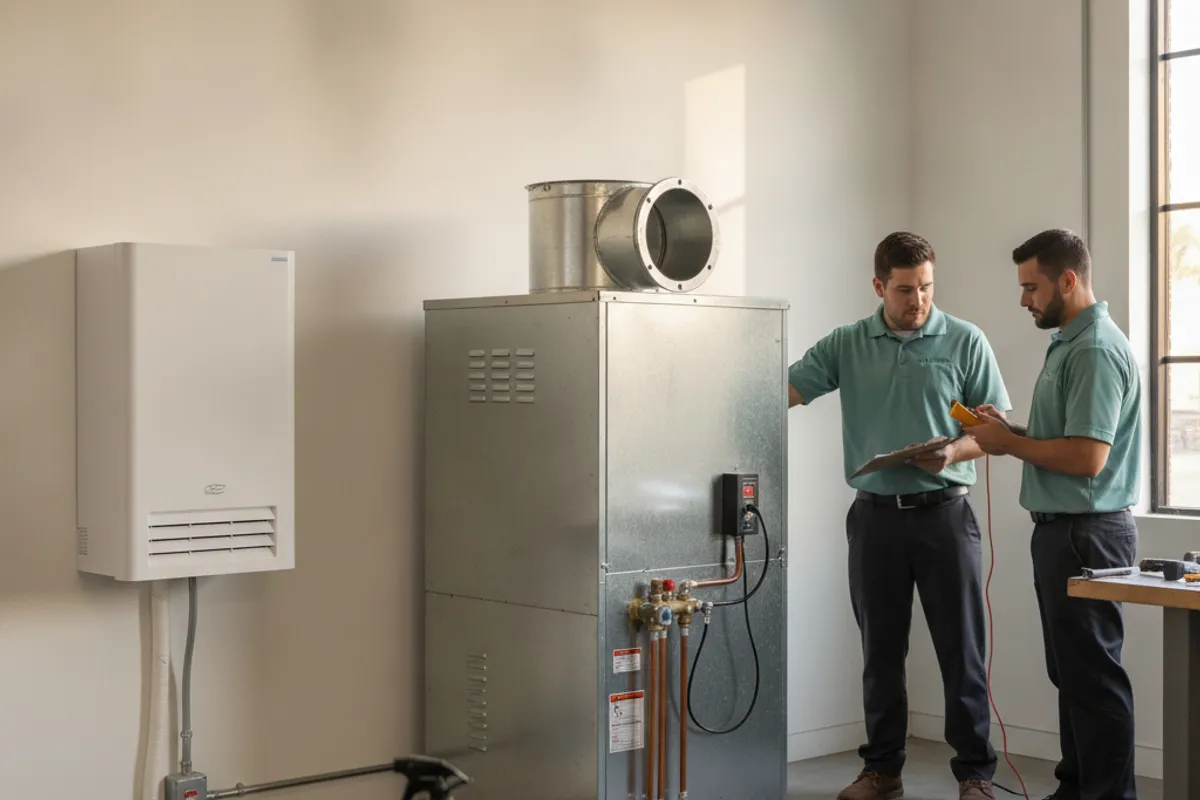
Two approaches to the same problem
Both ductless mini-splits and central heat pumps move heat into and out of your home using the same refrigeration cycle. The difference is delivery: a central system uses ductwork to distribute conditioned air throughout the house from a single air handler, while a ductless mini-split mounts individual indoor heads directly in each room or zone without ducts.
Which one belongs in your home depends on whether you have existing ductwork, how many rooms you need to condition, access for indoor units, and what the written proposals actually cover. Price is not a county band on this page.
What a ductless mini-split is
A ductless mini-split has two main parts: an outdoor compressor unit (similar in size to a central AC condenser) and one or more indoor air handlers mounted high on a wall. A small hole through the exterior wall carries the refrigerant lines and electrical connection between the two. No ducts, no central air handler, no furnace.
Single-zone systems pair one outdoor unit with one indoor head. Multi-zone systems connect one outdoor unit to more than one indoor head. The manufacturer’s documentation for the proposed outdoor unit sets how many indoor units it can support. Do not treat a website average as that limit.
In San Diego, mini-splits show up frequently in a few scenarios: older homes without existing ductwork, additions or ADUs where running duct to the new space would be expensive, garages converted to living space, and homes where one or two rooms have persistent comfort problems the central system cannot solve.
What a central ducted heat pump is
A central heat pump uses an outdoor compressor unit and an indoor air handler connected to the home’s duct system. The air handler pushes conditioned air through the same supply and return ducts that an existing gas furnace and AC would have used. If your home already has ducts in good condition, a central heat pump is a straightforward replacement for that existing equipment.
Central systems are a single point of control when the ducts form one connected system: one thermostat, one filter location, one air handler. They can be a fit when the existing ducts are in usable condition. Adding new ducts to a home that has none is a separate construction project with its own permits, access, and cost, which belong in a written bid rather than a published range.
Cost comparison for San Diego
Heat Pro SD does not publish installed prices. Ask each bidder for an itemized quote that separates equipment, line sets or ducts, electrical work, permits, and commissioning. EnergySage publishes national marketplace averages for heat pump projects; those figures are not San Diego quotes and do not tell you what a specific house will cost. Compare proposals that specify the same models and the same rooms.
If the home has no ducts and you need whole-home conditioning, ask whether a multi-zone mini-split or new ductwork is being proposed, and why. If the home already has ducts, ask for a duct assessment before treating central replacement as automatic.
Efficiency comparison
ENERGY STAR’s quality-installation and heat-pump guidance emphasizes matched equipment, airflow, and installation details. Duct leakage can waste conditioned air on a central system; a mini-split delivers air at the indoor unit. That difference is a reason to inspect ducts, not a license to quote a percentage loss for an unseen house. See ENERGY STAR air-source heat pumps.
Ask for the certified efficiency of the exact combination being quoted. Do not treat a generic SEER2 band as proof that one system type always wins.
Running only the rooms in use can reduce runtime on a zoned mini-split. Whether that saves energy in your house depends on how you occupy the space and how the system is controlled.
Comfort differences
Mini-splits allow true zone control. The bedroom can be 68°F while the living room is 72°F. Family members with different temperature preferences can adjust their own zones without affecting the rest of the house. This is a meaningful practical advantage in larger homes.
Central systems condition the whole connected duct zone simultaneously. You can add zoning dampers to a central system, but that adds complexity and cost. A well-designed central system with a variable-speed heat pump can condition connected rooms together. Whether it controls moisture well depends on runtime, airflow, and the house. It cannot isolate rooms the way individual mini-split heads can.
Aesthetics and installation
Mini-split indoor heads are visible on the wall. In a modern or minimalist interior, a white rectangular wall-mounted head looks clean. In a traditional home with wood trim and crown molding, some homeowners find it less appealing. There are ceiling cassette and floor-mounted indoor units that can reduce the visual impact. Ask the proposal to price those options separately instead of assuming they cost more.
Central systems keep all equipment in utility spaces: the outdoor unit, the air handler in a closet or attic, and only grilles visible in the ceiling or floor. No equipment visible in living spaces.
Installation disruption depends on the house and the proposed layout. Ask the contractor how many wall penetrations, attic or closet visits, and electrical changes the written scope includes. Do not rely on a one-to-two-day average.
Which is right for your San Diego home?
A ductless mini-split is usually the better answer if: your home has no existing ductwork, you are conditioning an addition or detached casita, you want room-by-room control, or you have one or two problem areas the central system can’t handle.
A central ducted heat pump is usually the better answer if: your home already has ductwork in usable condition, you want a single-thermostat whole-home solution, or the aesthetics of wall-mounted heads are not a fit for your interior.
For help comparing options, visit the San Diego heat pump service area page. The Heat Pro SD line is voicemail with a recording-consent notice. Leave a message at (858) 400-4374. Heat Pro SD matches homeowners with licensed independent HVAC pros and performs no physical work.
Is a mini-split more efficient than a central heat pump?
Mini-splits avoid duct leakage at the indoor unit. Central systems can perform well when ducts are sealed and sized for the equipment. Ask for duct findings and the certified ratings of the proposed combination instead of a universal efficiency winner.
How many rooms can a multi-zone mini-split handle?
The outdoor unit’s manufacturer documentation sets the supported indoor-unit count. Ask for that sheet for the model being quoted.
Can I add a mini-split to a home that already has central AC?
Yes. Mini-splits and central systems can coexist. A common approach in San Diego is to run central HVAC in the main living areas and add a single-zone mini-split to a bedroom, home office, or bonus room that the central system doesn’t reach effectively.
Ready to compare options? See our heat pump services. The Heat Pro SD line is voicemail with a recording-consent notice. Leave a message at (858) 400-4374 to request a match with a licensed independent heat pump pro serving San Diego County.