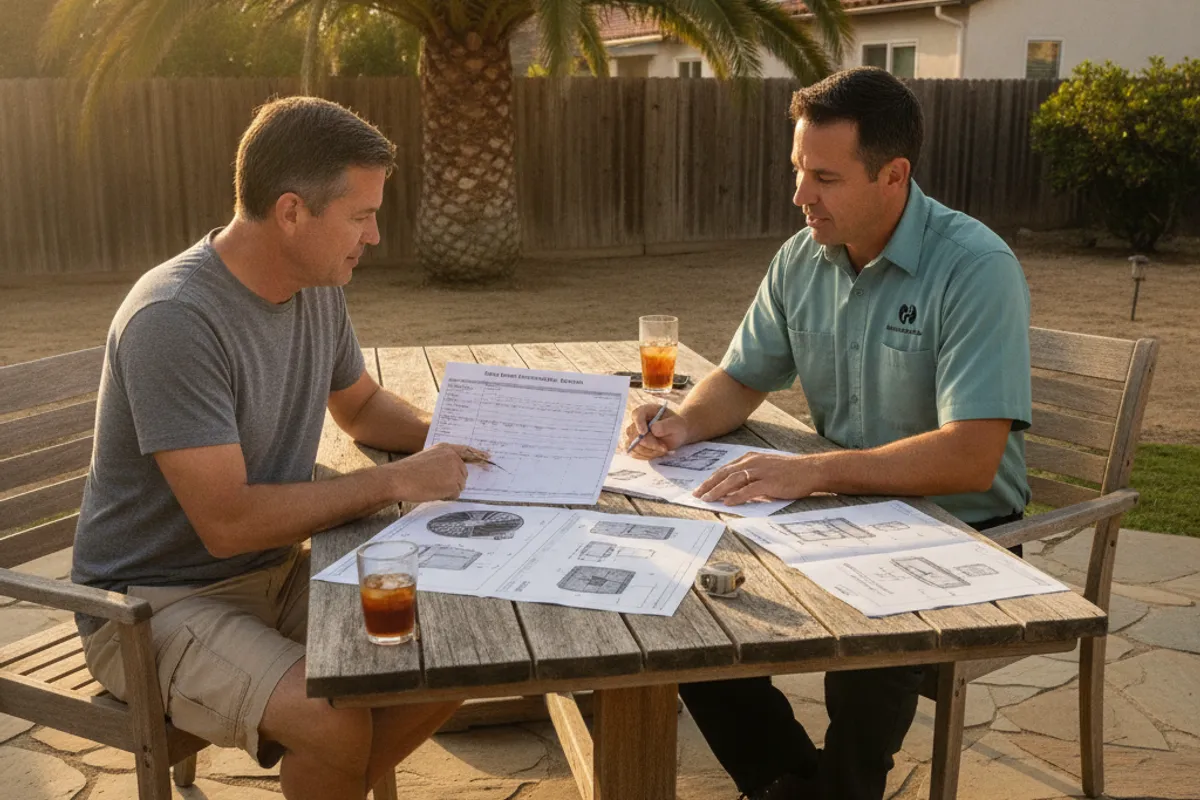
Why the installer matters as much as the equipment
A heat pump that is sized, charged, and connected poorly can underperform for as long as it stays on the house. You cannot judge that from a brand name on a brochure. You judge it from who is licensed to do the work, what they put in writing, and whether a permit and inspection are part of the job.
Heat Pro SD matches San Diego County homeowners with licensed independent HVAC pros. We perform no physical work. The number below is voicemail. Use this page to screen the contractor you actually hire.
Verify the C-20 license before anything else
Heating, ventilation, air-conditioning, and refrigeration contracting in California is a C-20 Warm-Air Heating, Ventilating and Air-Conditioning classification. The Contractors State License Board issues that license.
Look the number up yourself at the CSLB license check before you sign. Confirm:
- The license is active
- The name on the license matches the company on the contract
- The classification covers the HVAC work being proposed
- Any disciplinary record is something you are willing to accept
Do not take a license number from a business card as proof. A contractor who is licensed will not object to you checking the Board’s site.
Anyone who advertises as a contractor is held to contractor rules. Unlicensed contracting is a misdemeanor under California Business and Professions Code section 7028, unless an exemption applies.
Ask for insurance documents, then keep the contract honest
Ask the contractor for current certificates of general liability and workers’ compensation. Read the named insured and the dates. Heat Pro SD does not insure crews and cannot vouch for a policy.
On a home-improvement contract, California caps the down payment at $1,000 or 10 percent of the contract amount, whichever is less. On a large job that cap is $1,000, not 10 percent of the total. See B&P section 7159.5.
Work under $1,000 is not automatically unlicensed. The statutory exemption also requires that no building permit is needed, and splitting a job to stay under the dollar limit is excluded. See B&P section 7048. For a heat pump, treat licensing and permits as the default, not the exception.
Permits belong in the quote
Ask, in writing, who pulls the mechanical permit and which city or county office has jurisdiction. If new circuits or panel work are part of the job, ask who holds the electrical license and who pulls that permit.
Treat these as walk-away signals:
- Saving time or money by skipping the permit
- “Inspectors do not really check around here”
- A quote that never mentions permit fees or responsibility
A permit does not prove the system will be comfortable. It does create an inspection record and a paper trail at resale. Manufacturer warranties often require a permitted installation. Ask the contractor to show that requirement in the warranty document for the exact model.
Get at least two itemized quotes
One quote is a number with no comparison. Two quotes let you compare models, scope, and exclusions. Three quotes make outliers easier to see.
When you line them up, look for:
- Exact outdoor and indoor model numbers, not only brand and tonnage
- A Manual J load calculation, or a written statement that one will be done before equipment is ordered
- Permit responsibility and fees, listed
- What happens to existing equipment, including refrigerant recovery
- Separate warranty documents for equipment and for the contractor’s labor
Do not pick the lowest total if the scopes are different. A missing line item is not a discount.
Questions that separate a real proposal from a sales visit
“Will you pull a permit for this job?” You want a yes, with the issuing office named.
“Can you walk me through your load calculation method?” Square-footage rules of thumb and “same size as what is there” are not a load calculation.
“What SEER2 and HSPF2 are printed for this matched system?” The contractor should read those from the proposed combination, not from a generic brand page. SEER2 and HSPF2 are not interchangeable with older SEER and HSPF labels.
“What refrigerant does the nameplate list?” Get the designation from the equipment or the manufacturer’s spec sheet. Do not rely on a guessed transition date or a refrigerant family you read online.
“Who is authorized to handle the refrigerant on this job?” Ask for the credential the contractor will use, in writing. Do not treat a website badge as the record.
Red flags
- A price without a visit to the home
- No load calculation in the process
- A total far below the others with a thinner scope
- Pressure to sign the same day or to lock a deposit for a limited price
- Cash only, with no written contract
- A contract that never names models, permit responsibility, or warranty terms
What a usable contract includes
Before work starts you should have a written contract that states:
- The exact equipment models and what is excluded
- Total price, payment schedule, and what triggers each payment
- Who pulls and pays for permits
- A project sequence, not a marketing timeline
- Labor warranty terms as the contractor writes them, not a typical industry number
- Manufacturer warranty documents for the equipment
- How unexpected conditions, such as duct repairs, get priced and approved
Heat Pro SD does not install, commission, or pull permits. We match homeowners with licensed independent HVAC pros. The Heat Pro SD line is voicemail with a recording-consent notice. Leave a message at (858) 400-4374.
What license should a heat pump installer have in San Diego?
A C-20 license from California’s CSLB for the HVAC work. Verify it at the Board’s official lookup before you sign.
How many quotes should I get for a heat pump installation?
At least two, and three if you can. Compare equipment, scope, and exclusions, not only the bottom line.
What if a contractor offers to skip the permit to save money?
Walk away. Ask the next bidder who pulls the permit and which office inspects.
Ready to compare licensed independent HVAC pros? See our heat pump services or leave a voicemail at (858) 400-4374. Heat Pro SD performs no physical work.