A Valley Center house that blows warm air on a still inland afternoon is usually a heat pump with a cooling fault, not a coastal window unit in disguise. Homes off Valley Center Road, Cole Grade Road, and Lilac Road sit farther from the ocean than Mira Mesa or Kearny Mesa, so the outdoor unit works harder in dry heat. Heat Pro SD matches you with a licensed independent pro for heat pump repair in cooling mode. The brand does not send a crew or open the equipment itself.
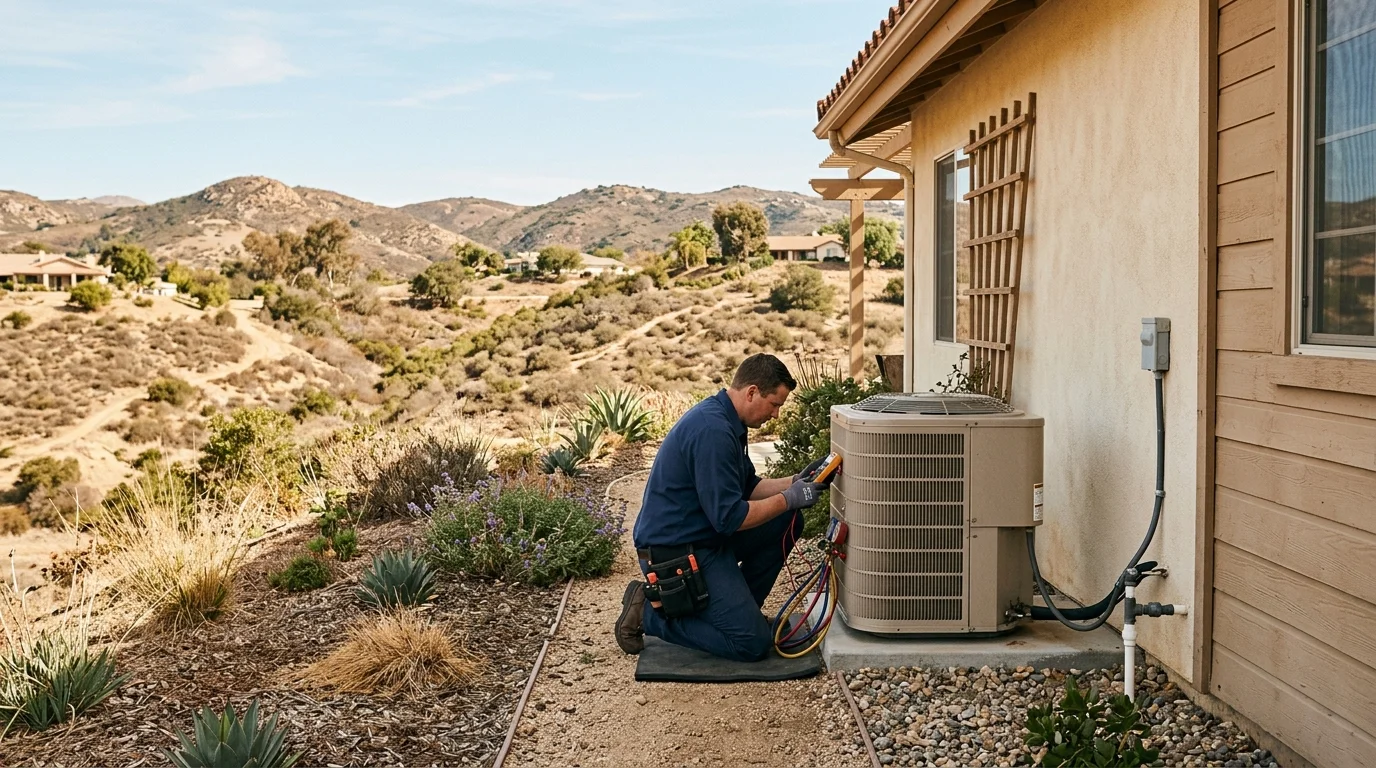
How to confirm the cooling system is a heat pump
Searchers type ac repair valley center ca because the outdoor box looks like an air conditioner. On many inland North County lots, that box is a heat pump. It cools in summer by moving heat out of the house. It heats in winter by reversing that flow. If you only describe it as “the AC,” the matched pro still has to guess at the reversing valve, defrost controls, and heat mode on the thermostat.
Stand outside and look at the unit without removing panels. A heat pump outdoor unit has refrigerant lines, a fan, and a data plate. The plate is the honest label. Photograph the model, serial number, and any heating and cooling ratings printed there. If the plate lists both heating and cooling, you are not dealing with a cool-only condenser. If the indoor closet or garage has an air handler and no gas furnace vent, that is another heat pump clue. A hybrid home can still have a furnace backup. Say so if you see gas piping at the indoor unit.
Check the thermostat next. Heat, cool, auto, and a setting labeled emergency heat or auxiliary heat point to a heat pump. A cool-only control is rarer on these rural lots, but it exists on older add-on systems. Do not force modes you do not understand. Write down what is on the screen: mode, setpoint, fan setting, and any error code.
Valley Center’s inland climate makes this ID step load-bearing. A unit that “always ran as AC” still has to heat on cool nights in the backcountry. That year-round duty is why heat pumps in the San Diego backcountry fail in ways a beach condenser does not. Share the photo of the data plate when you call. The licensed contractor uses it to pull the right diagram before anyone talks parts.
If you cannot read the plate, say that plainly. Dust, faded stickers, and brush around the pad are common on larger lots. The pro can still identify the equipment on site. Guessing the brand from memory wastes the visit.
What to check without opening the equipment
Stay out of the electrical compartment. Capacitors, contactors, and high-voltage lugs are not homeowner work. California treats HVAC contracting as licensed work once the job needs a permit or the contract is at or above the state threshold. Unlicensed contracting is a misdemeanor under Business and Professions Code section 7028. Photograph, note, and stop.
Set the thermostat to cool, fan on auto, and a setpoint a few degrees below the room temperature. If the display is blank, replace the thermostat batteries if it uses them, then wait. Many heat pump controls hold the compressor off for a short restart delay after a shutdown. That pause is a manufacturer setting, not a Valley Center building code, and no three-minute legal rule for air conditioners could be confirmed. If the indoor fan starts and the outdoor unit stays silent after several minutes, write that down.
Change or inspect the filter if you can reach it without tools. Dry inland lots load filters with dust from driveways, groves, and open soil. A packed filter starves the indoor coil and can make a healthy heat pump look dead. Do not wash a disposable filter and put it back wet.
Walk to the outdoor unit. Look through the grate. Note whether the fan is spinning, whether grass or insulation is packed against the coil, and whether you hear a hum with no fan. Keep pets and kids back. If you smell burning plastic, shut the system off at the thermostat and at the breaker, then treat it as a stop-and-call problem.
Open supply registers in the rooms you use. Closed vents on a long rural duct run make a heat pump not cooling valley center complaint that is really an airflow complaint. Look for ice on the copper lines at the outdoor unit. Ice means stop the cooling call and let the coil thaw with the fan on, then tell the pro you saw ice. Do not chip it.
If air comes out warm while both indoor and outdoor fans run, read why a heat pump blows warm air in San Diego and keep those notes. Warm air with a silent outdoor fan is a different ticket from weak airflow with a roaring outdoor fan.
How thermostat and airflow symptoms differ
A thermostat fault and a dying outdoor fan can feel the same from the sofa. They are not the same repair. Separate what the control is asking from what the ducts are delivering.
Thermostat-side clues: the screen is blank or looping, the mode flips by itself, the setpoint does not match what you set, or the system ignores cool and sits in heat. On a heat pump, a wrong “emergency heat” setting can run strip heat and never start the outdoor compressor. That burns power and still leaves the house hot in a Valley Center afternoon. Write the exact mode names. Do not cycle the breaker every few minutes. Short restarts stress the compressor.
Airflow-side clues: the outdoor unit sounds busy, the filter is gray, one wing of the house is hot while the hall is fine, or registers barely push air. Large-lot homes here often have long duct runs through hot attics or crawl spaces. A leak or a crushed flex run on the west side of the house will not show up on the thermostat. Rooms over the garage and additions off the original ranch plan are the usual weak zones.
Noise helps split the two. A rapid on-off cycle with strong airflow can be a control or a safety switch. A steady indoor blower with no outdoor fan is often electrical or a failed outdoor motor. Gurgling in the lines with weak cooling is a refrigerant-path symptom. None of those names a “most common part.” A licensed pro tests capacitors, contactors, fans, coils, and charge before naming a failed part. Internet lists that crown one part as the usual failure are not a diagnosis for your pad.
Share timing. A unit that cools at 8 a.m. and falls behind after lunch on Cole Grade Road is fighting inland load and maybe dirty outdoor fins. A unit that never starts after a brief power blink is a control or lockout issue. Those two stories send the matched contractor down different checklists.
Which Valley Center property details to share
The matched pro cannot see your lot from the phone. Valley Center is rural inland North County. Equipment sits farther from the house than it does on a Mira Mesa tract pad. Longer line sets, extra fittings, and sun-baked insulation change both diagnosis and parts. Say how far the outdoor unit sits from the indoor air handler, even if you only pace it.
Give the access story. Gated drive, dirt lane, low tree canopy, dogs, and a unit behind a slope all change how the visit works. Shade cloth, plywood, and stored lumber against the coil matter. So does irrigation spray hitting the electrical box. Dry-country dust cakes coils faster than coastal mist. If you recently graded, mulched, or had grove work done, say that.
Name the building pattern. Original ranch, added ADU, converted garage, or a shop on the same electrical service. A mini-split on the casita and a ducted heat pump on the main house are two systems. Do not assume one visit covers both. If a generator or transfer switch is on site, mention it. Do not claim a runtime or an outage schedule you have not measured.
Valley Center is unincorporated. Building permit rules for replacement and for work that needs a permit are set by the County of San Diego, not by a city hall on Valley Center Road. A local ordinance number for heat pump work could not be confirmed here. Ask the county before anyone starts a swap. The contractor who will pull a permit, if one is required, is the licensed independent pro, not Heat Pro SD.
Photograph the breaker labels, the filter size, and the outdoor pad. Note whether neighbors’ units are running. That last detail sounds small. On a 95-degree inland afternoon it tells the pro the problem is likely in your equipment, not a neighborhood outage.
When repair and replacement both deserve comparison
Ask for both paths in writing when the outdoor compressor is in question, when the coil is leaking, or when the matched pro says the unit cannot hold a cooling load on a typical Valley Center afternoon. A small electrical part can restore cooling. A failed compressor often lands on the same conversation as a new outdoor unit because the labor, recovery, and remaining indoor coil all sit on one ticket. No verified local price list belongs on this page. The pro quotes the job. Heat Pro SD does not.
California’s home-improvement deposit cap is specific. Under Business and Professions Code section 7159.5, the down payment shall not exceed $1,000 or 10 percent of the contract amount, whichever is less. On a large replacement that means $1,000, not 10 percent of the whole job. There is no verified “$5,000 AC rule” in the claims we can publish. If someone quotes a round number as a state rule, ask them to show the statute.
Licensing has its own $1,000 line. As of January 1, 2026, Business and Professions Code section 7048 exempts work only when the aggregate contract price for labor, materials, and all other items is less than $1,000, the work is casual or minor, and a building permit is not required. Both the dollar test and the permit test have to hold. Splitting a job to stay under the line does not create an exemption. Anyone who advertises as a contractor loses that exemption at any price. Check the person at the CSLB license lookup before you sign.
New equipment a contractor would install has to clear a federal minimum efficiency rating. SEER2 is a harder test than the older SEER scale, so the same hardware scores lower under SEER2. Do not compare the two numbers as if they were equal. A licensed installer quotes compliant equipment. Rebate dollar amounts and open-or-closed status change during the year, so they are not stated here. Confirm any incentive with the program that actually pays it, on the day you are quoted.
Use heat pump replacement as the comparison track when repair cannot restore reliable cooling, when the indoor and outdoor sections are badly mismatched, or when the written diagnosis says the remaining coil or ducts will strand a new compressor. Age by itself is not a published lifespan figure on this site. Condition, parts availability, and the inland load on your lot are.
What the written diagnosis should explain
A useful diagnosis is a short paper trail, not a vibe. Before anyone orders a part, the licensed contractor should write what was tested, what failed, and what still works. Ask for the outdoor model and serial, the indoor model if they reached it, and the mode the thermostat was in when they arrived.
The cooling story belongs in measurements, not adjectives. Air temperature at a main supply and at a return, outdoor air temperature at the pad, and whether the outdoor fan and compressor were both running are the basics. If they weighed in refrigerant or found a leak, the page should say where they looked and whether they repaired a leak or only noted it. Adding refrigerant on a leak without fixing the leak is a delay, not a repair.
Electrical notes should name the part they condemn: capacitor, contactor, motor, board, wiring, or breaker. “Bad electrical” is not enough. Airflow notes should name the filter condition, coil access, and any crushed or disconnected duct they actually saw. On a long Valley Center run, “needs more airflow” without a location is incomplete.
Repair versus replace should sit on that same sheet. Parts availability, whether the indoor coil matches a new outdoor unit, and whether a county permit would apply to a swap are fair lines. Dollar figures you cannot source from that quote do not belong in the conversation. Deposit terms should match the $1,000-or-10-percent cap above.
Keep the photos you took before the visit. Compare them to the write-up. If the diagnosis never mentions the iced line, the buried coil, or the emergency-heat setting you reported, ask them to address those items before you approve work. Heat Pro SD’s role is the match. The warranty, if any, is the contractor’s, on the contractor’s paper.
When to call us
Call when the heat pump will not cool, ice is on the lines, breakers will not hold, or a written repair quote needs a second look against replacement. Heat Pro SD matches Valley Center homeowners with licensed independent HVAC contractors and does not perform the work. Call us at (858) 400-4374 and we’ll connect you with a licensed local HVAC contractor.